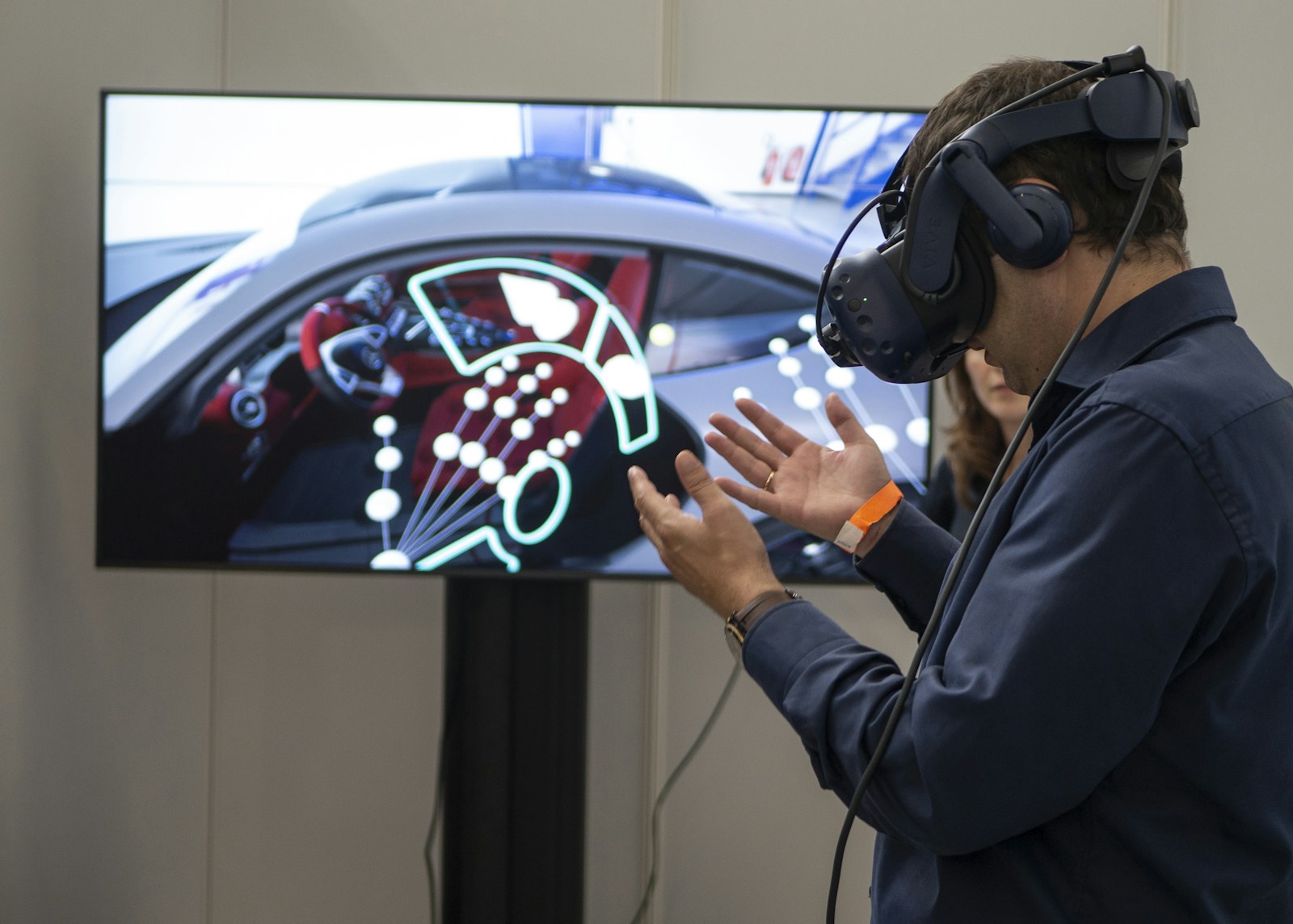
I'm standing in a forest that doesn't exist, reaching out to touch a tree that has no physical form, and the experience is indistinguishable from reality. This is NeuroLink VR, the first consumer headset to incorporate direct neural interface technology, and after two weeks of testing, I can confidently say: everything changes now.
Forget everything you know about virtual reality. The clunky headsets, the motion sickness, the visible pixels, the awkward controllers — all of it becomes obsolete the moment you put on NeuroLink's sleek, lightweight device and let it read your thoughts.
How It Works
NeuroLink VR uses an array of 256 non-invasive neural sensors that detect electrical patterns in your brain with unprecedented precision. Unlike previous BCI (Brain-Computer Interface) systems that required surgical implants, this technology sits comfortably against your scalp and decodes your intentions in real-time.
"We're not reading your thoughts — we're reading your intentions. There's a crucial difference."
That's Dr. Lisa Chang, NeuroLink's Chief Science Officer, addressing privacy concerns that have surrounded the device since its announcement. The system only detects motor intentions and emotional states — the kind of pre-conscious signals that occur when you decide to move or react. Your private thoughts remain private.
The Experience
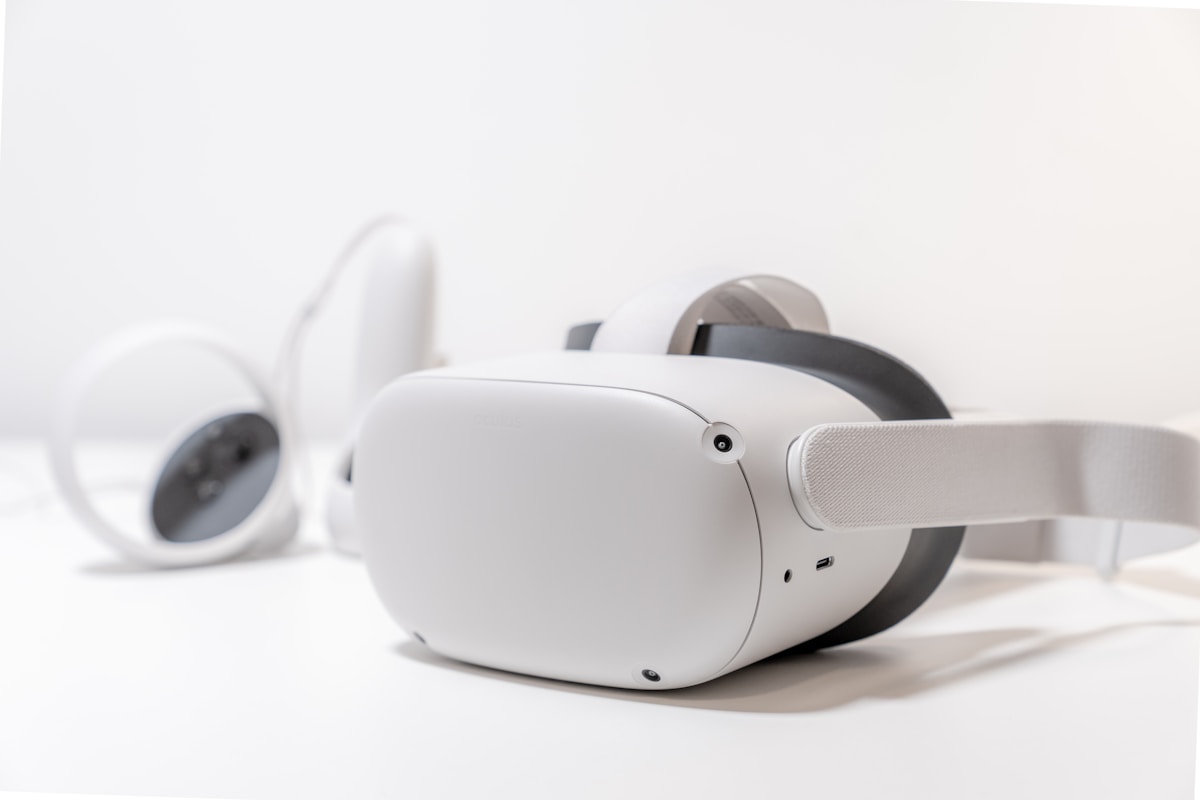
After a 15-minute calibration process where the device learns your unique neural patterns, you're ready to enter virtual worlds in a way that no previous technology has allowed. The key innovations:
- Thought-based movement: Want to walk forward? Just think about walking. Your physical body stays still while your virtual self moves naturally.
- Intuitive object interaction: Reaching for objects happens as naturally as in real life. The system predicts your intentions and begins rendering your virtual hand movement before you consciously complete the thought.
- Emotional haptics: The device detects your emotional state and adjusts the virtual environment accordingly. Feel tense? The lighting softens. Feel curious? Hidden details reveal themselves.
- Zero latency: By predicting your actions 50 milliseconds before you consciously make them, the system eliminates the delay that causes VR sickness.
Testing the Limits
I spent two weeks putting NeuroLink VR through its paces across various applications. Gaming, as expected, is transformed. Playing a sword-fighting game where your weapons respond to thought rather than physical movement is initially disorienting, then exhilarating, then utterly natural.
But the non-gaming applications may be more significant. Virtual meetings where your avatar's expressions perfectly mirror your emotional state. Therapeutic applications where psychologists can adjust environments based on patient stress levels in real-time. Training simulations where instructors can see exactly when a student's confidence wavers.
The implications for accessibility are profound. Users with physical disabilities can navigate virtual spaces with the same freedom as anyone else. One beta tester with quadriplegia described the experience as "the first time in fifteen years I've felt truly free to move."
Privacy and Concerns
No technology this intimate comes without concerns. NeuroLink has published their data handling policies — neural patterns are processed locally on the device and never transmitted to external servers. But critics point out that the company's privacy policy allows for "anonymized aggregate data collection for product improvement."
There's also the question of what happens when this technology becomes more precise. Today's device reads motor intentions. Tomorrow's might read emotions with perfect accuracy. Next decade's might access deeper cognitive processes.
The Verdict
At $1,499, NeuroLink VR is not cheap. But it's also not just an incremental improvement over existing VR — it's a fundamental leap forward. For the first time, the barrier between thought and virtual action has been effectively eliminated.
We're witnessing the birth of a new paradigm in human-computer interaction. Whether that's exciting or terrifying depends on your perspective. But one thing is certain: there's no going back to pushing buttons and waving controllers. The mind-machine interface has arrived, and it works.
Rating: 9.5/10
Deep Dive: The Neural Interface Technology
To truly understand what makes NeuroLink VR revolutionary, we need to examine the science behind its neural interface. I spent a day at NeuroLink's research facility in Austin, Texas, speaking with the engineers and neuroscientists who made the impossible possible.
The key breakthrough came from a new approach to electroencephalography (EEG). Traditional EEG systems detect electrical activity on the scalp's surface, but the signals are weak and noisy — like trying to hear a whisper across a crowded room. Previous consumer BCI devices could detect only the most basic signals: intense concentration, relaxation, or crude directional intentions.
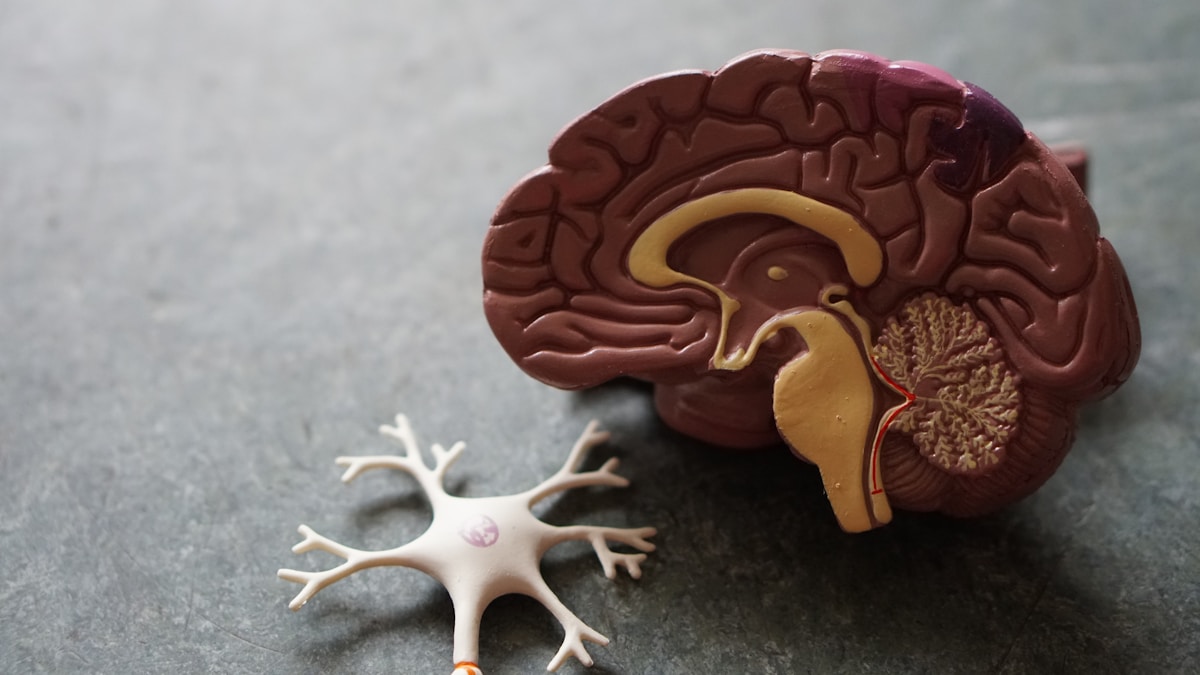
NeuroLink's innovation was developing what they call "coherent neural imaging" — a technique that uses machine learning to extract meaningful patterns from the noise. The 256 sensors don't just record; they work together to triangulate the sources of neural activity, creating a three-dimensional map of brain function that updates 1,000 times per second.
The Calibration Experience
The 15-minute calibration process is surprisingly engaging. The system presents you with a series of tasks: imagine reaching for objects, think about walking in different directions, recall specific emotions. With each task, the AI builds a personalized model of your unique neural patterns.
What struck me was how the system adapts to individual differences. Dr. Chang explained that no two brains are identical — the neural signature for "reach forward" varies significantly between people. The calibration process essentially teaches the AI your brain's particular language.
After initial calibration, the system continues learning. Over days and weeks of use, the neural model becomes increasingly refined. Power users report that the device becomes more responsive over time, anticipating intentions with almost unsettling accuracy.
Gaming: A Complete Transformation
I tested NeuroLink VR across a dozen games, from first-person shooters to puzzle adventures to social worlds. The experience varied, but the transformation was consistent: this is not an incremental improvement over traditional VR.
In combat games, the advantage is immediate. When your weapon responds to thought rather than physical movement, reaction times shrink dramatically. The 50-millisecond prediction window means your virtual actions begin before you consciously complete the decision to act. Competitive players report feeling like they're seeing the future — their virtual selves acting on intentions they're still forming.
Exploration games reveal different strengths. Walking through a virtual forest, I found myself naturally reaching out to touch trees, picking up objects out of curiosity, pausing to examine details — all through thought alone. The friction between intention and action disappears entirely.
Social VR may be the most profound application. When your avatar's expressions reflect your actual emotional state, virtual conversations achieve a naturalness that previous systems couldn't match. I attended a virtual concert with friends spread across three continents. For the first time in a virtual space, I forgot I was wearing a device.
Beyond Entertainment: Professional Applications
While consumer gaming drives headlines, NeuroLink VR's most significant impact may be professional. Several industries are already adopting the technology:
Surgery training: Medical schools report that students using NeuroLink VR master surgical procedures 40% faster than those using traditional VR or physical simulation. The thought-based interface allows trainees to focus entirely on the procedure rather than translating intentions into controller movements.
Architecture and design: Architects can walk through buildings that exist only as data, manipulating structures by thought. Design iterations that once took days happen in hours. Clients can experience spaces before ground is broken.
Therapy and rehabilitation: Physical therapists use NeuroLink VR for patients recovering from strokes and spinal injuries. By imagining movements they can't yet physically perform, patients maintain neural pathways and accelerate recovery. Early results are remarkable.
Corporate collaboration: Remote teams report that NeuroLink VR meetings feel more like in-person gatherings than any previous technology. Emotional states are visible. Attention is apparent. The uncanny valley of previous avatars gives way to genuine presence.
The Addiction Question
With any transformative technology comes concern about misuse. Critics worry that experiences this immersive could be dangerously addictive. Why engage with messy reality when virtual worlds respond perfectly to your thoughts?
NeuroLink has implemented "digital wellness" features: usage timers, break reminders, and optional limits. But the company is clear that responsibility lies with users. "We build tools," Dr. Chang said. "How people use them is ultimately their choice."
Psychologists are divided. Some see therapeutic potential — controlled environments for treating anxiety, phobias, and trauma. Others worry about dissociation, escapism, and a generation that may prefer virtual existence to physical reality. The long-term effects won't be known for years.
What Comes Next
NeuroLink's roadmap hints at capabilities that sound like science fiction. Future versions may detect not just motor intentions but semantic content — understanding what users are thinking about, not just that they're thinking. Bi-directional interfaces could send information to the brain as well as reading from it, enabling direct neural feedback.
The company is careful to emphasize that they're pursuing beneficial applications: helping locked-in patients communicate, restoring sensory function to those who've lost it, augmenting human capabilities rather than replacing them. But the same technology that helps could also harm. The ethical frameworks we develop now will shape how these capabilities unfold.
The Verdict Revisited
After two weeks with NeuroLink VR, I find myself reluctant to return to traditional interfaces. The friction of controllers, the delay of physical movement, the disconnect between intention and action — all feel suddenly archaic. This is what it must have felt like to switch from command lines to graphical interfaces, from keyboards to touch screens.
The device isn't perfect. Battery life is limited to four hours. The sensor array requires careful positioning. Some users report headaches during extended use. The price excludes most consumers. These are real limitations.
But they're the limitations of a first-generation product that will improve rapidly. The core innovation — direct neural interface with consumer-grade hardware — is here. Everything else is iteration.
We are at the beginning of a new era in human-computer interaction. NeuroLink VR is its herald.
Final Rating: 9.5/10